GEO
GEO: the traffic goes to the AI, and mostly stays there
What I found while preparing a GEO workshop for an international news organisation in November 2025: where the users went, why the clicks did not follow, and the twelve questions every team has to answer before GEO can become a product.
In November 2025 I ran a long GEO workshop with an international news organisation. GEO means Generative Engine Optimization, aka AI SEO, LLM SEO, AEO or just “showing up in the AI”. The goal: get their heads around it and figure out how to turn GEO into a product.
They did not want a LinkedIn buzzword pitch. They wanted the harsh, data-based truth. Here are the graphs I came up with during the research phase, and the questions we ended up working on.
GEO was “invented” in spring 2025
AI has been coming for quite a while. But look at Google Trends for GEO: the topic barely exists, then it takes off in March and April 2025. Put it next to SEO for scale.
Why then? Because businesses saw something in their Google Search Console data.
With the rollout of AI Overviews in Europe, March to May 2025, the “blue” line (clicks) to European web properties went down. The “violet” line (impressions) went up. New positions in the AI Overviews, search results that nobody clicks, though.
It is pretty obvious that the traffic went to “the AI”. So who is “the AI”?
Who “the AI” is
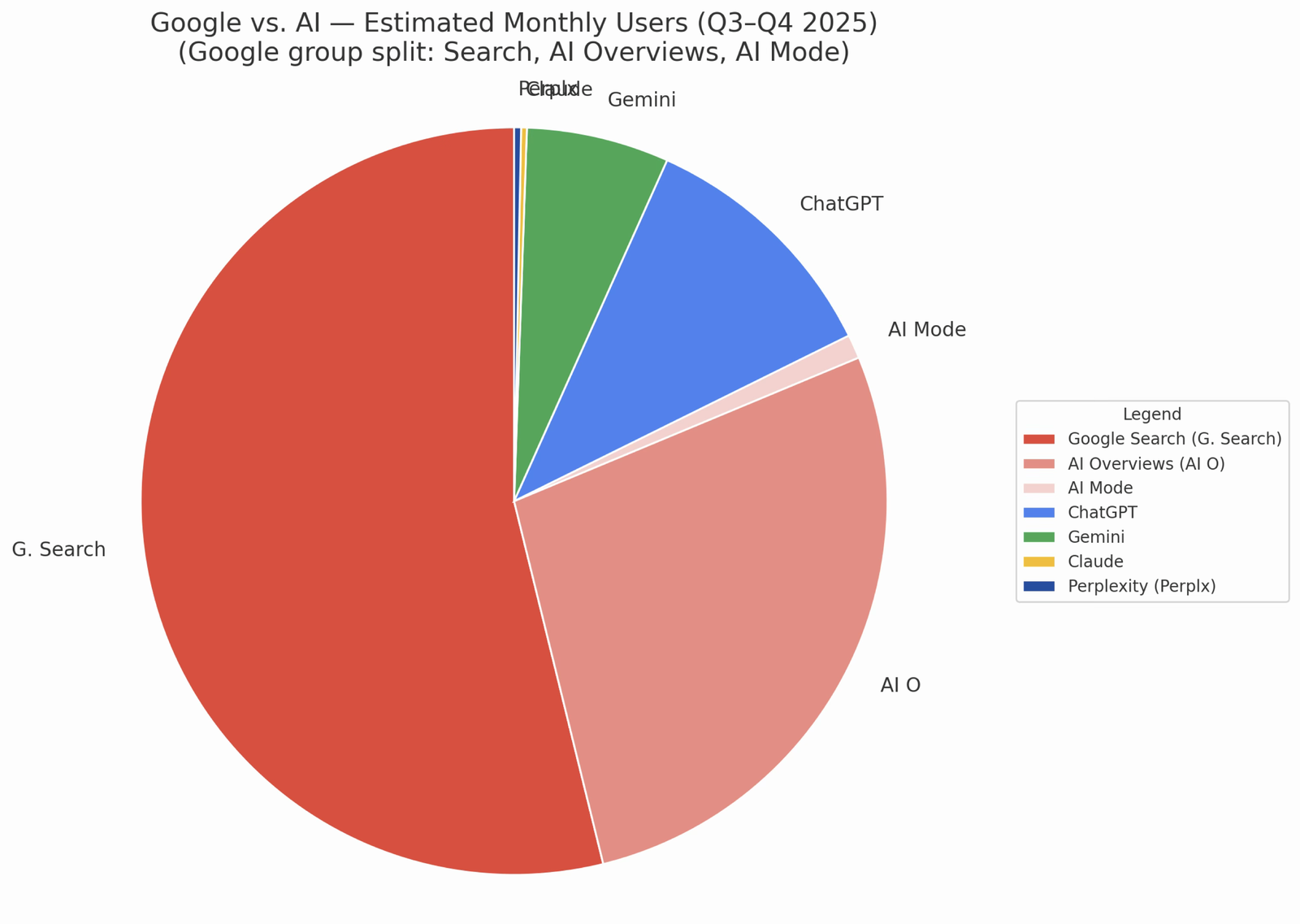
Market share data is hard to get. This is what I could find, monthly active users, as of 2025:
- Google Search: ~4.0B MAU (estimate, based on StatCounter’s Google share)
- AI Overviews: 1.5 to 2.0B MAU (The Verge, Q1 2025; TechCrunch, Q2 2025)
- AI Mode: 100M+ MAU (Google, CEO remarks Q2 2025)
- ChatGPT: ~800M MAU (TechCrunch)
- Gemini app: ~450M MAU (Alphabet IR, Q2 2025)
- Perplexity: ~22M MAU (Business of Apps)
- Claude: ~16 to 19M MAU (Backlinko)
Put that into a pie and Google Search is still the biggest slice. But ChatGPT sits at 20%+ and AI Overviews at around 30%. The blue Google part of that pie is why Google has been freaking out for the last two years.
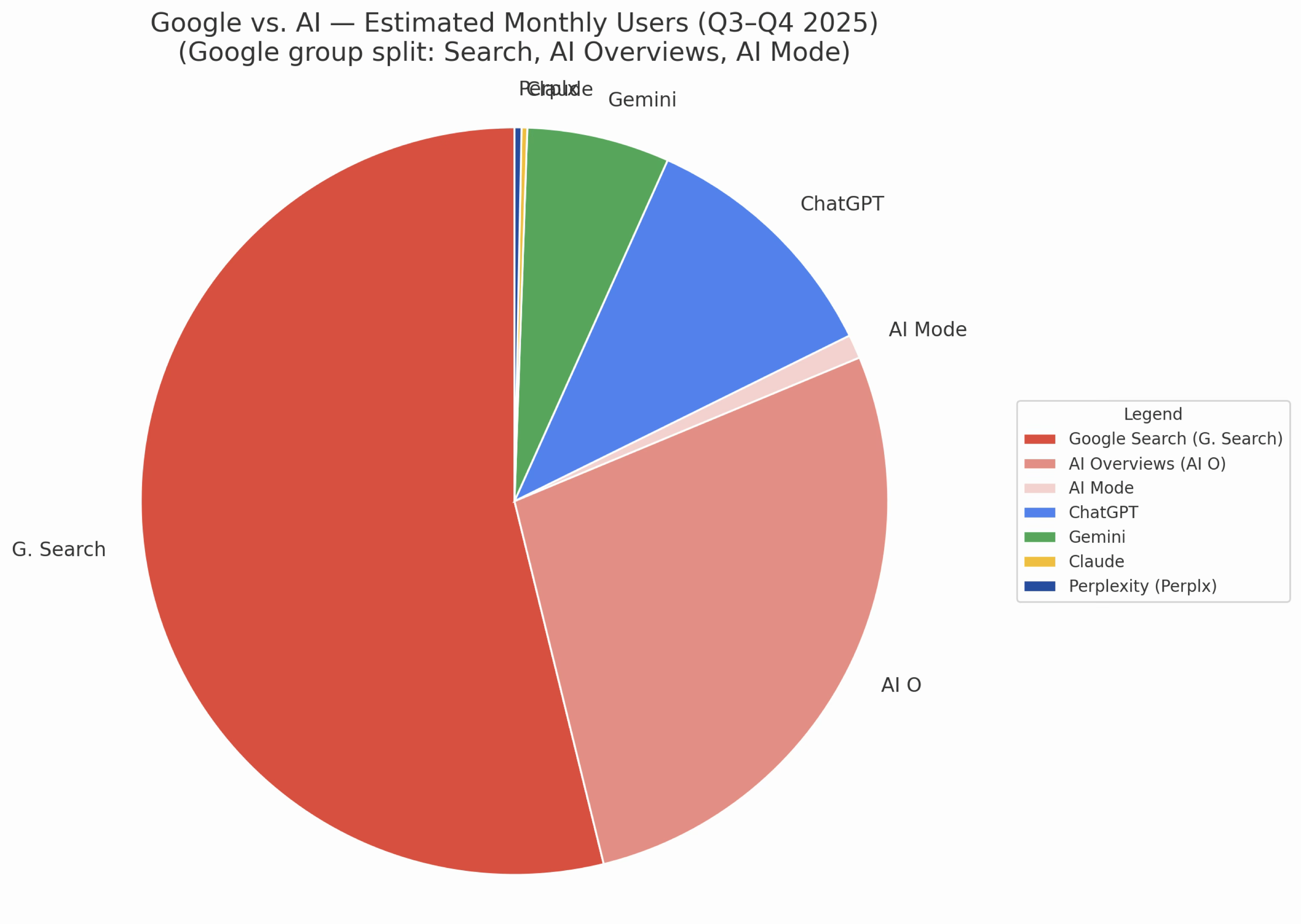
Where the clicks actually come from
Now look at the second pie: the traffic that actually arrives on websites. I used an example GA4 graph of a multi-site web property with diversified traffic streams. Your pie will look majorly different. But the pattern holds, and I bet it holds for you too:
- ChatGPT hardly ever brings more than 2% of the traffic to a web property.
- AI Overviews are not separately reportable at all.
- All other AIs are squished together into an unreadable mini slice.
So the users are clearly going to “the AI” (first pie). That does not mean the traffic goes through the AI to the websites (second pie).
AI Overviews and chat interfaces like ChatGPT, Gemini and AI Mode are not designed or intended for click-through. Users get the answer right there. That is why they are popular in the first place.
AI is not search. A prompt is not a search query.
The questions every GEO team has to answer
With the traffic going to “the AI” and mostly staying there, this is the list we worked through:
- What is the value of showing up in AI Overviews, ChatGPT or Gemini, if the interfaces are not designed for the user to click through, because they get the answer right away?
- If the value is unclear, what is the goal of GEO?
- How do we measure that goal?
- What is the difference between optimizing for AI Overviews and for ChatGPT or Gemini?
- Is AI Overview optimization, Gemini optimization and ChatGPT optimization one topic? Where do they overlap, where do they differ?
- Where do GEO tasks and processes live in the organisation? Is it even SEO? Or is it just SEO?
- YouTube is the second biggest search engine, Amazon the third. But we do not usually throw them into the SEO topic. Where does GEO belong?
- What is the difference between optimizing for the LLM training set and optimizing for LLM retrieval (RAG) via search?
- How do you optimize for query fan-out in AI Overviews, and what is it worth? Google itself says AI Overviews and AI Mode may issue multiple related searches across subtopics to build an answer.
- What can we really say about new GEO tasks and processes, what is speculation, and what is just b*llshit?
- What can we learn from SEO in the 2000s and early 2010s, when the data basis was equally thin?
- How do we test our hypotheses?
One surprising find
A lot of the articles that performed well in ChatGPT were old. Published in 2023 or earlier, never even updated. Something that definitely needs a deeper look.
No final answers (yet)
Are there 100% final answers? No. GEO is an emerging business discipline.
SEO took about eight years (from ~2004 to ~2012) to become a proper data-based, strategic, repeatable business practice. We will see how long it takes for this channel. And it is a damn fast-moving target.
It was a great session. And these questions are the honest starting point for any team that wants to make GEO more than a buzzword.

About the author: Franz Enzenhofer. Practitioner. Author. Trainer.
- SEO since 2004
- Author of the book "Understanding SEO"
- AI First since 2022
Sources
The claims in this article rest on these sources.
- Franz Enzenhofer newsletter, 2025-11-11: Last week I had this GEO workshop.
- Google Trends, Generative Engine Optimization, last 5 years
- Google Trends, Generative Engine Optimization vs Search Engine Optimization, last 5 years
- Franz Enzenhofer, pie chart: AI market share including Google Search (monthly active users, 2025 estimates)
- MAU estimates as compiled in November 2025 from StatCounter, The Verge (Q1 2025), TechCrunch (Q2 2025), Google CEO Q2 2025 remarks, Alphabet IR (Q2 2025), Backlinko and Business of Apps
- Google Search Central, AI features and your website (query fan-out)
Image credits
- Franz Enzenhofer (chart built from published monthly active user estimates)