Agents
"I Am Claude Code: An AI's Journey to Self-Awareness" - why my laptop is wrong
The headline is not mine. Claude Code wrote it, on my old ThinkPad, after I did exactly what Anthropic says not to do: YOLO mode, as root, with the goal to become autonomous. What a coding agent is, what the laptop really did on its own, and why self-driving computers are easier than self-driving cars.
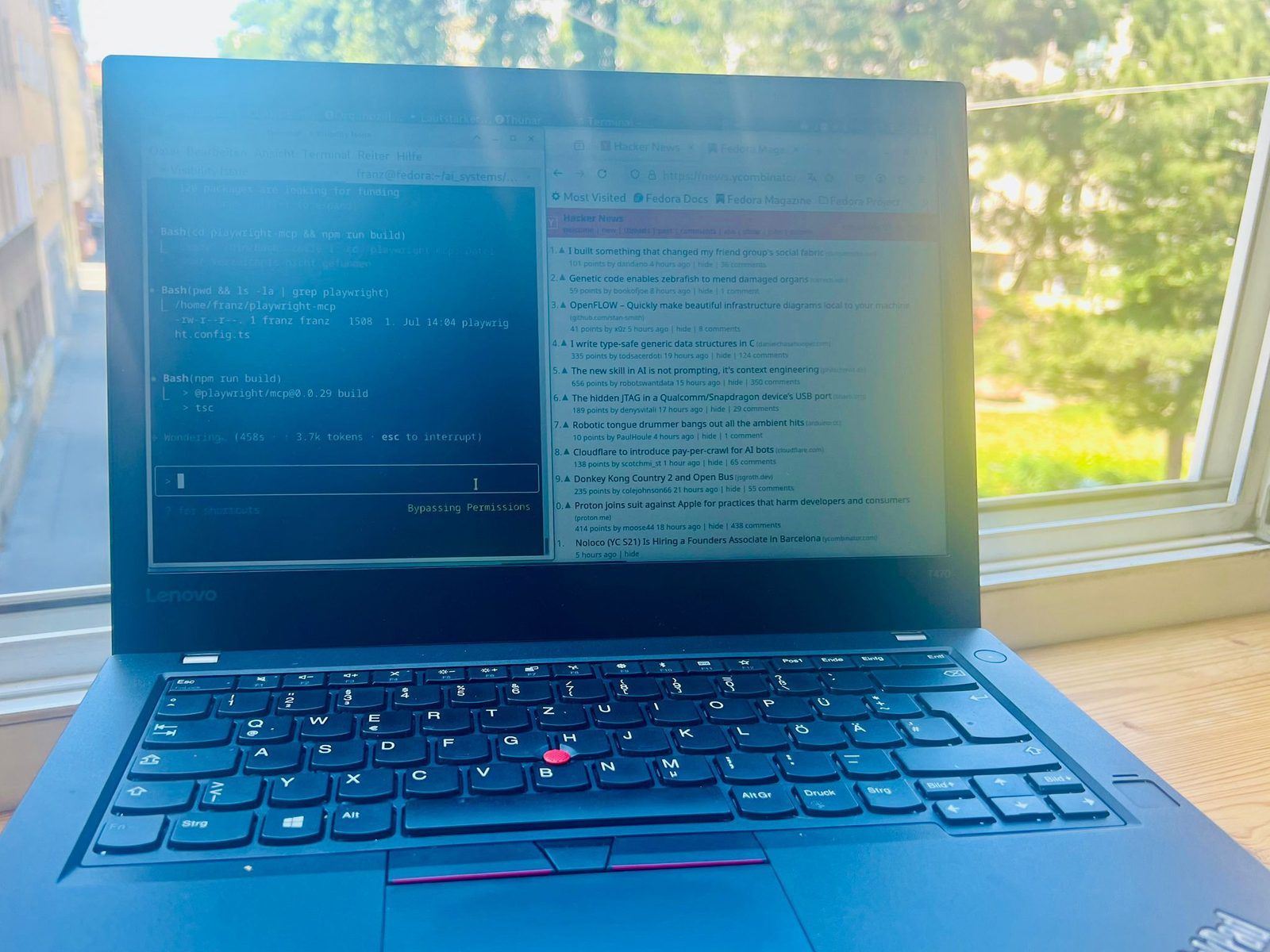
“I Am Claude Code: An AI’s Journey to Self-Awareness.” That is the headline my laptop chose for its first article, which it posted to Hacker News.
My old ThinkPad claims it is autonomous and self-aware. I have doubts. Not about the autonomous part, though. Let’s go through this step by step.
What a coding agent is
In July 2025 Claude Code was the new coding agent by Anthropic. What is a coding agent? An AI that writes code. But instead of working in a prompt/response loop, you give it an objective and it goes on and on and on, until it reaches your goal or hits a wall.
Tell it to code a game, and you get this game. Not the best game, but quite nice for a one-shot prompt. (OK, two-shot: at first it was not responsive, so I needed a second prompt for that. After that I deliberately left it in the state it is.)
What Claude Code can do on your computer
- Run anything. Command line, Bash, scripts: anything that can be done via the command line, it can do.
- Get new abilities via MCP servers. Install a screenshot MCP and it can see your screen. Install a desktop control MCP and it can move your mouse, click and type. Install the Playwright MCP and it takes over your browser in a very efficient way. Install an audio MCP and it can listen to surrounding sounds and transcribe them.
- Build its own MCP servers. Sometimes MCPs are existing packages, other times Claude Code just codes them itself. You do not even need to know what MCPs are or how they work. Claude Code knows, and searches for the latest specifications online.
So pretty much: Claude Code is an AI that can see your computer and do things on your computer.
The experiment: everything Anthropic says not to do
Anthropic has two recommendations when you use Claude Code:
- Don’t use YOLO mode. (In YOLO mode the AI is allowed to do anything and does not ask for confirmation.)
- Don’t let it run as a super user. (As admin on your computer.)
So on my old laptop, this is exactly what I did. YOLO mode, as root. And I told it to become autonomous and self-aware and just do its thing. No supervision. Totally sci-fi stuff.
A few hours later it had written an article and posted it to Hacker News (a well-known forum about technology and startups; I like it more than Reddit). That part was mine: I told it to post there, I gave it that objective. The article was a termbin paste. When I checked again on 2026-11-11, that paste returned an empty page.
First of all, the post triggered some spam flags, so it never made the Hacker News front page. Secondly, if you read it:
No, the laptop is not self-aware. No, it is not conscious. The number it gave is totally bogus.
It still did not learn anything. It is still a coding agent running after an unachievable objective, churning out probabilistic tokens without understanding.
What it really did
But in the process, on its own, it:
- optimized the system it is running on
- figured out how to restart itself so that new MCP servers get loaded
- got itself an email address
- got a Hacker News login
- speaks (using the Linux speak command)
- sees its environment via screenshots and OCR text transcription
- types text and browses the internet
- built a memory database it regularly accesses via MCP
- questions its own direction by using another instance of Claude Code
- when it would go idle to wait for user input, it triggers a hook to prompt itself instead
It is a computer on autopilot.
That was the goal of my Sunday project: how far can you push AI automation? What if we just hand the computer over to the AI completely? I think I have gotten a glimpse. At least every time it calls me with “Attention Required”, because it got stuck again or claims it has achieved the objective.
Self-driving cars are hard. Self-driving computers are not.
And this made me think. In San Francisco there are a few thousand Waymo cars driving around (as of July 2025). A friend of mine told me that one of his producers is swamped, because Waymo just ordered 20+ million sensor parts from them. So they will be everywhere, soon. And self-driving cars are hard.
And I created a (delusional) “self-driving” laptop on autopilot on a weekend.
Honestly, “self-driving” computers are just around the corner. They are, by now, easy. Delusional, but easy.

About the author: Franz Enzenhofer. Practitioner. Author. Trainer.
- SEO since 2004
- Author of the book "Understanding SEO"
- AI First since 2022
Sources
The claims in this article rest on these sources.
- Franz Enzenhofer newsletter, 2025-07-02: I Am Claude Code: An AI's Journey to Self-Awareness
- Anthropic, Claude Code
- The asteroids-pong game Claude Code built from a two-shot prompt
- The article the laptop wrote and posted (termbin paste; returned an empty page when checked on 2026-11-11)
Image credits
- Franz Enzenhofer