AI First
The same 12 points, minted to AI: Donella Meadows' leverage points for AI First
Donella Meadows ranked 12 places to intervene in a system, from tweaking numbers to changing paradigms. I mapped all 12 onto a company going AI First, and one of them decides more than your whole AI budget.
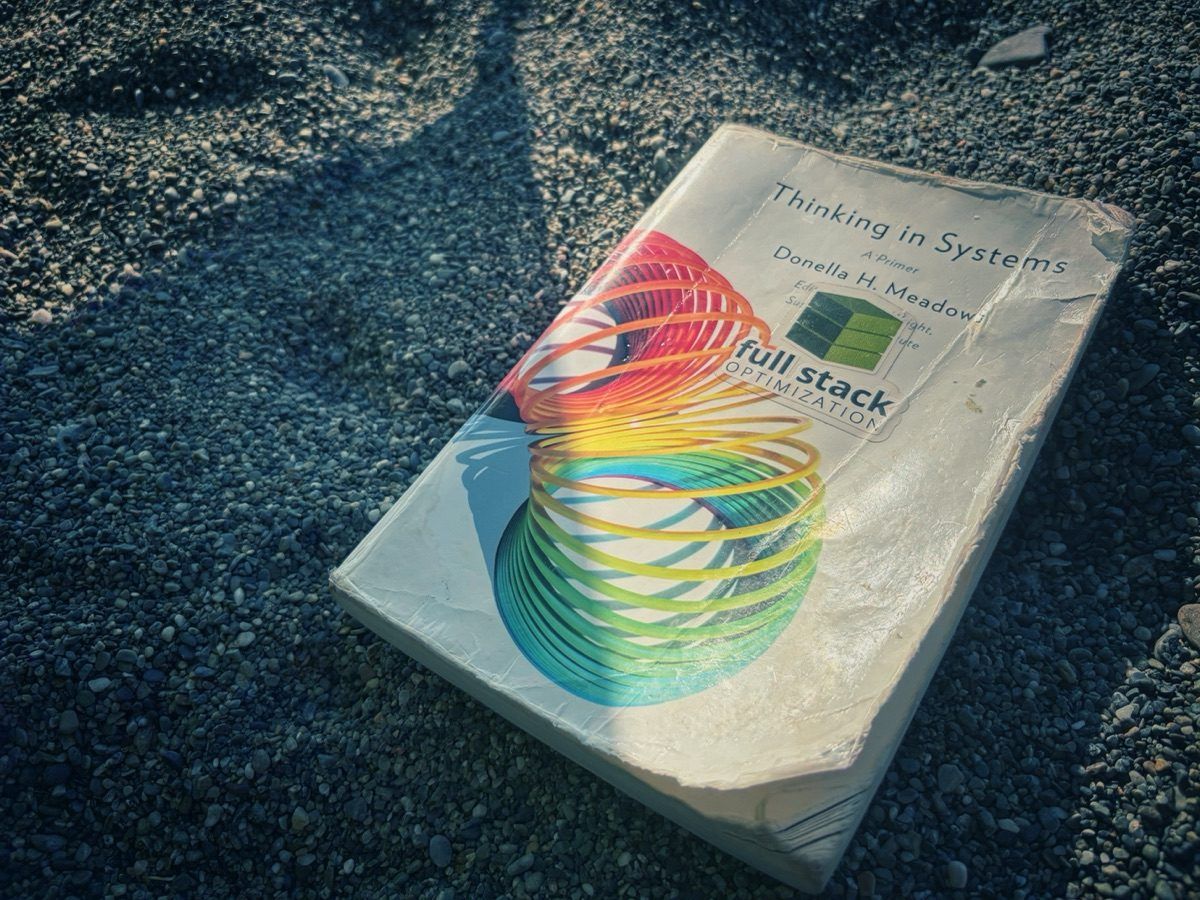
There is one book I read every year, or every other year by now. Donella Meadows, Thinking in Systems: A Primer. I basically modelled my career around this book. In summer 2026, on vacation, I read it again. And this time I read it with one question in my head.
Who she was
Donella Meadows, 1941 to 2001. Environmental and systems scientist. Lead author of “The Limits to Growth”, 1972. 29 years at Dartmouth. MacArthur Fellow.
The book is posthumous. Drafted in 1993, finished from that draft by Diana Wright after Meadows died, published by Chelsea Green in 2008.
My 10 years book rule: if a book is good enough that people still recommend it 10 years after publishing, it is probably worth reading. This one I am not only recommending, I have been reading it for nearly 18 years now. Again and again.
Why the question matters right now
I sold my first AI workshop in December 2023. By August 2026 I had done 25 of them, in 2026 on average one every three and a half weeks.
The workshops changed massively. In the beginning it was all about prompting into chats, working around hallucinations and copy-pasting code snippets into a self-made web editor, to get around the limits of the chat view and the locked-down company computers of the participants.
Now we run multiple agents in the workshop that spawn subagents on full-featured AI First desktops in the cloud, accessible via the browser. From context management, AGENTS.md and CLAUDE.md files to goal setting, service integrations and agents (claws) that run 24/7, autonomous or with a human in the loop.
And still, we are only touching the surface. At the time of writing, two befriended companies are changing themselves to real AI First. They rebuild every process and every role around AI: product, dev, QA, HR, management. Old roles vanish, new ones get invented. Old limitations are gone. New ones get discovered. New territory.
So if you change a system - an organisation, a company - to AI First: where do you make the most impactful changes?
That is exactly the question Meadows answered for systems in general.
Donella’s original list: the 12 leverage points
Meadows laid out her leverage points in the essay Leverage Points: Places to Intervene in a System and again in the book. Here is her list in reverse order, from Nr. 12, the least impactful (least is not “no impact”), down to Nr. 1, the most impactful:
- 12. Constants, parameters, numbers (such as subsidies, taxes, standards)
- 11. The sizes of buffers and other stabilizing stocks, relative to their flows
- 10. The structure of material stocks and flows (such as transport networks, population age structures)
- 9. The lengths of delays, relative to the rate of system change
- 8. The strength of balancing feedback loops, relative to the impacts they are trying to correct against
- 7. The gain around driving reinforcing feedback loops
- 6. The structure of information flows (who does and does not have access to information)
- 5. The rules of the system (such as incentives, punishments, constraints)
- 4. The power to add, change, evolve, or self-organize system structure
- 3. The goals of the system
- 2. The mindset or paradigm out of which the system - its goals, structure, rules, delays, parameters - arises
- 1. The power to transcend paradigms
The same 12 points, minted to AI
Same order, same logic. This is my mapping. It is a work in progress, and there is a lot left to discover.
- 12. Constants, parameters, numbers: seats, tokens, model tiers, spending limits.
- 11. The sizes of buffers and stabilizing stocks: whatever absorbs the speed difference between agents and people. The pile of unreviewed machine output: draft folders, PR queues, staging. Too small, and people drown in AI output. Too big, and finished work rots unused.
- 10. The structure of stocks and flows: whether an agent gets a limited chat window or access to a full computer - and what that computer is wired into: systems, data, credentials.
- 9. The lengths of delays: the doing got fast, the learning did not. The agent ships in a minute. The real-world mistake surfaces in three weeks. In the meantime a thousand bugs like it have shipped. The AI acts faster than the feedback comes in.
- 8. The strength of balancing feedback loops: monitoring, rollback, review. Checks must run at the speed of what they check.
- 7. The gain around reinforcing feedback loops: agents writing the skills that make the next agent better. And, going the other way, agent slop feeding agent slop.
- 6. The structure of information flows: what the machine gets to see. Not just input data, but the outcome of its own actions: Search Console, Analytics, CRM, tickets, code, invoices, logs.
- 5. The rules of the system: permissions, budgets, incentives, definition of done. Who signs off, and who carries the responsibility when the AI screws up. Not if, when. A machine does not carry responsibility.
- 4. The power to self-organize: teams build and kill their own agents, tools and roles. If everybody is a developer, can everybody deploy?
- 3. The goals of the system: what the company is using AI for. Cut costs, fire people, or do and build what was previously impossible.
- 2. The mindset or paradigm: AI First.
- 1. The power to transcend paradigms: AI will be like electricity, just how things work. How we use computers, how we create value. And so at some point it will be superseded itself.
Nr. 3, the goal: replace you, cut costs, or build the impossible?
Let’s pick just one point.
I put this list together in a taverna in Greece (damn, it was hot, but worth it). And while doing that I realised one thing about Nr. 3, the goal.
It does not matter how much you invest into AI First. If your employees, your team, or even just you believe that AI is here to replace you, to make you redundant, then the organisation you build will be a very different one from the organisation that sets out to build the impossible.
Simple logic: the people who are supposed to make AI work are the same people AI is supposed to replace. Nobody builds their own replacement well. So the cost-cutting AI organisation will look for reasons why it does not work, will not work, why AI just sucks. And it will find them.
You might still get an AI chatbot button on your website. You will not get the impossible.
Same tools, same seats, same tokens: Nr. 12 looks identical in both companies. Nr. 3 decides which company you become.
Oh, and the goal must not only be stated. It must be believable and trustworthy. A real goal. Not just a slide headline.

About the author: Franz Enzenhofer. Practitioner. Author. Trainer.
- SEO since 2004
- Author of the book "Understanding SEO"
- AI First since 2022
Sources
The claims in this article rest on these sources.
- Franz Enzenhofer newsletter, 2026-08-17: AI First Leverage Points: where to make the most impactful changes
- Donella Meadows, Leverage Points: Places to Intervene in a System (1999), The Donella Meadows Project
- Donella Meadows, Thinking in Systems: A Primer, Chelsea Green, 2008
Image credits
- Franz Enzenhofer