GEO
Some honest thoughts about GEO: no data, no playbook, a moving target
In September 2025 my LinkedIn feed was a wall of confident GEO advice, and most of it could be neither verified nor falsified. Here is where Generative Engine Optimization really stood, why it looks like SEO in the 2000s, and where to start anyway: with data.
Fair warning: this is mostly bad news.
Whenever I open LinkedIn, I am greeted by a wall of GEO, AI SEO and LLM SEO posts. Every shape, every flavor, each with an engagement-bait intro and the “newest, best” (and usually repetitive) claims. They range from “nothing changes” to “… is dead” to “everything changes”, or a mixture of all three.
And lo and behold, most of them are … how to put it nicely … neither verifiable nor falsifiable. Hypotheses phrased as truthful advice. Or, simply put: they are b*llshit. They really are.
How this kind of advice gets made
I believe the process looks something like this:
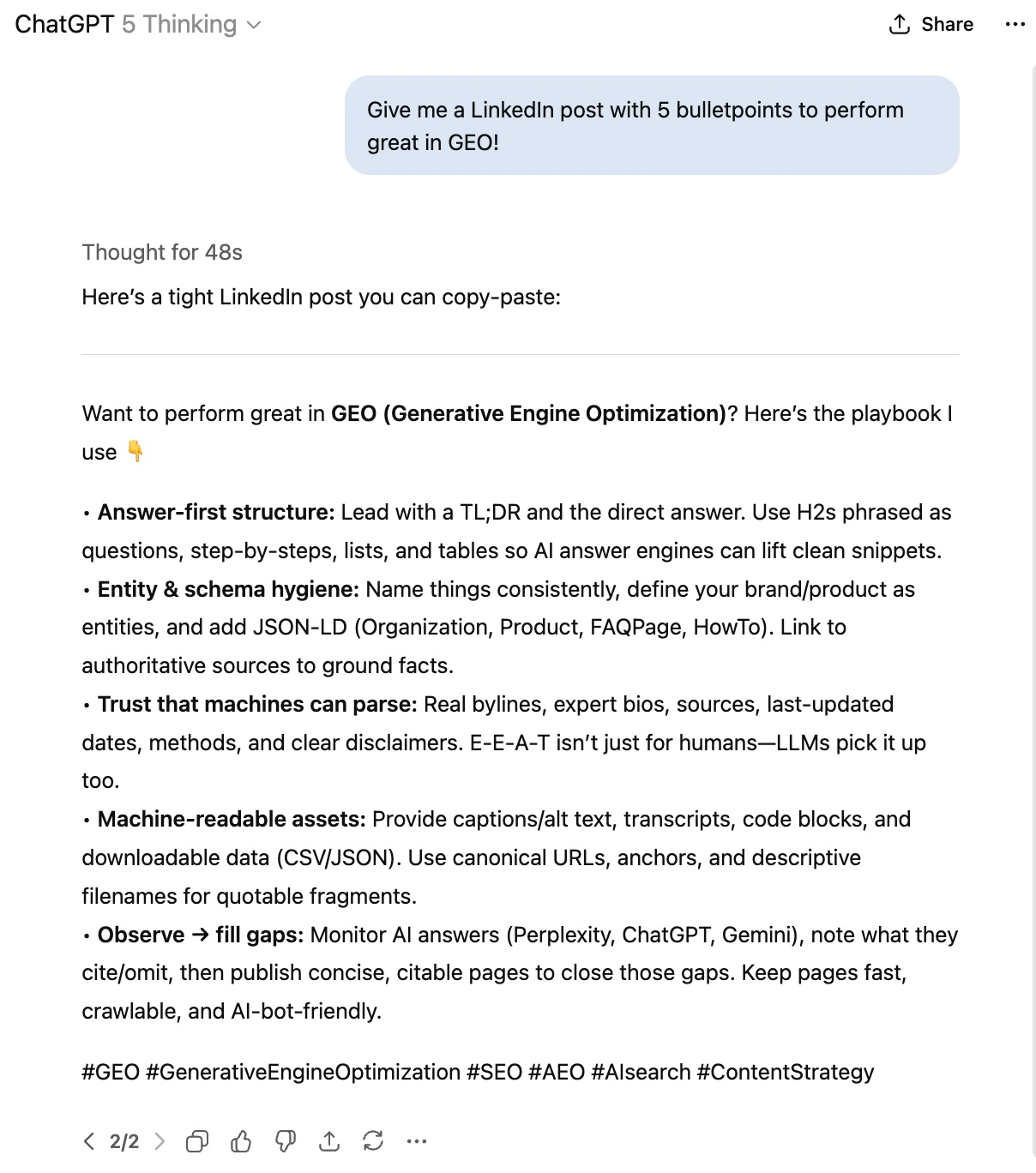
- Go to ChatGPT.
- Prompt: “Give me a LinkedIn post about GEO.”
- Take the output as real advice and post it on social media.
Just to be clear: that is neither how LLMs work nor how you should use them.
What comes out is a good-sounding, confident paragraph that has it all: answer first, schema.org, EEAT, CSV/JSON. But it has nothing to do with facts. It is not based on any specification, established best practice, data or research.
An AI does not “know” facts. It generates concatenated strings of tokens, a.k.a. best guesses. Best guesses that are sometimes so good they can be mistaken for intelligence. But best guesses about a field that is still developing are not very good best guesses. Especially when they are framed as advice, as fact, or as a social media post.
Where GEO is right now
As of September 2025 there are three major challenges with GEO, Generative Engine Optimization.
1. Insufficient data. We do not know what people actually type into ChatGPT (no prompt data; the SEO analogy is having no query data). We do not know when we show up (no impression data). And we only partially see when users click a link that leads to our web property (insufficient click data, only partial traffic data in on-page analytics).
For Google AI Overviews we have a bit more data. But well, Google does not make it easy to tell AI Overviews and AI Mode apart from classic search.
2. No clear best practices. We do not have stable, reusable playbooks. And we do not have the measurement system to verify them either.
3. A very fast moving target. The AI field moves fast. Even when the major versions (ChatGPT 5, at the time of writing) do not change often, the models get constantly tuned, changed and post-trained, without any announcement that something changed.
Yeah, sucks. It is what it is. GEO is not yet a mature business discipline. It is a field of hypotheses, experimentation and working with the thin data basis we have. GEO is a developing discipline, so treat it as one.
We have been here before
This is exactly where SEO was from the 2000s through the first few years of the 2010s. It took roughly eight years before best practices, including data analysis practices, were clear in SEO.
How long will it take for GEO? I don’t know.
But here is the thing: SEO was not a mature discipline for nearly a decade either, and people still worked it, with massive, massive success. It was hypothesis-driven: data setup, experimentation, trial, error, repeat. That is where we are now, too.
If someone tells you there are already clear best practices, just walk away. You have better things to do.
The difference today: classic SEO is solved, it is all about execution. GEO is not solved. The path forward has to be carved, charted and cleared by us, not handed to us. (If that does not scare you, write to me about an SEO/GEO project: fe@f19n.com.)
Where to start: choose data
Selling certainty in uncertain times would be easy. But there is none. Right now we are all in the same loop:
- refine the data setup
- experiment
- trial
- error
- repeat
Everybody is.
If you want to know where to start, choose data. The data in your on-page analytics (GA4, Matomo, …) is suboptimal, yes. But it is there, and there will be more of it over time.

About the author: Franz Enzenhofer. Practitioner. Author. Trainer.
- SEO since 2004
- Author of the book "Understanding SEO"
- AI First since 2022
Sources
The claims in this article rest on these sources.
- Franz Enzenhofer newsletter, 2025-09-17: Finally, Some Hard Data! - About GEO, AI First, Relaunch Wien.gv.at
Image credits
- Franz Enzenhofer (screenshot)